Dec 16 2011

Access to a world of practice

How communities of practice give us access to observing, orienting, deciding, and acting in a world of practice.

Happy Corner, where the tailors studied by Jean Lave (2011) worked in the 1970’s, was a remarkable community of practice.  The community provided resources an individual couldn’t afford like sewing machines or cutting tables, real-time help making or verifying calculations, opportunities to groom reputations or gossip, partners for more difficult projects, and enough competition to keep everyone on their toes in an evolving economy.  The apprentices in the community become master tailors and then took on apprentices themselves.  In a world where education steadily narrows down (to teach to the test, in the name of efficiency), there’s a lot we can learn from that tailor’s community: work and community were not separate, work and learning happened in the normal course of the day, without separating work or learning from the larger world.  An important point that Lave makes is that the apprentices were not only learning to sew buttons and cut trousers, they were learning about how the world actually works, about how to collaborate and compete, about who’s who, and about how to make a living in a changing marketplace and world–from a tailor’s point of view.

We all change as we participate in communities of practice.  But our communities also change as we participate in them.  And the world changes as communities evolve.  Participating in communities of practice gives us access to knowledge about sewing buttons (or whatever our practice involves) but also gives us access to meaningful observations, orienting, decisions, and actions in the world of practice.  So when we seek to cultivate or support a community, we need to pay attention to how a community can provide that access to that world.  For that it helps to have formal models of some sort, so we can make sense of, and further enable, learning at individual, community and environmental levels.  (Formal models also help us to not romanticize communities, too.)

In this post I use John Boyd‘s OODA loop model to highlight the strategic role that communities of practice can play in giving us access to and making sense of a rapidly changing environment.  An OODA loop, according to Wikipedia, is “a concept originally applied to the combat operations process, often at the strategic level in military operations (notably in the design of the F16 fighter jet). (It’s interesting that Boyd’s paper on “Destruction and Creation” (1976) describes some community and learning issues very well while using a very mathematical and mechanistic language.)  These days, OODA loops are also applied to understand commercial operations and learning processes.   I’m going to use a religious community to illustrate how an OODA loop model focuses attention on how communities give access to the world of practice and to a fast-changing environment.

Here’s an overview of the OODA model. OODA is an acronym for:

O Observe evolving situation, tempered with implicit filtering
O Orient based on our genetic heritage, cultural traditions, and previous experiences
D Decide on a strategy
A Act in an evolving environment that includes friend & foe

The diagram in the Wikipedia article shows how the OODA loop is all about feedback:
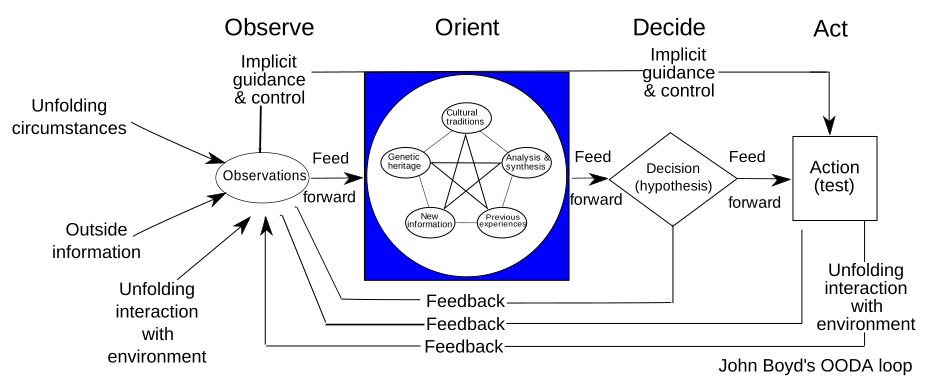
A conversation on one of Jerry Michalski’s Yi-Tan calls got me thinking about OODA loops as a framework for assessing the role that communities can play in providing insights to a changing world.  At the time one of my clients seemed to think of a community they were developing as an information dissemination mechanism instead of as a learning opportunity with strategic value.  I wondered whether an OODA loop model could help.

It seemed obvious to me that an OODA loop would be a handy way of describing feedback processes involved in learning a simple skill, whether alone or in a more social setting.  So let’s lay the ground by looking at different levels of feedback that are possible when someone is learning to ice skate.  (Thanks to Noah Sparks, a student at Pepperdine University, for getting me to think of how ice skaters learn.)

Learning to ice skate is all about feedback and balance: from our inner ear, from the horizon, and from the ice when we fall.  But trying to skate, falling, figuring out which way is up, getting up, trying it all over again, and keeping at it until we know how can leverage feedback on an individual as well as more social levels.
Learning in the company of others speeds things up and makes it a lot more fun.  Learning partnerships spring up at any moment according to our needs. When partnerships persist over time and involve a group of people, we have a community of practice, which harnesses very sophisticated feedback processes. An individual’s feedback loops are enriched when they have access to other people’s practice.
When we look at the world through a community of practice, at adjacent communities, skills, and resources, we realize that a community’s practice itself evolves over time because of feedback from a fast-changing world.  For example, ice skaters have adopted story-lines and costumes from myth-spinners like Disney to add excitement and commercial appeal to their practice.

Instead of counting or mapping nested OODA loops (individual, group, across-groups) à la system dynamics, it seems most useful to tease out the most significant feedback layers. In the ice skating example we  get involved in a community of practice when we find that repeating a personal OODA loop in isolation doesn’t work as well as we need.  A community of practice gives us access to other ice skaters who are making relevant observations, orienting themselves, making decisions, and acting. (In fact the term “practice” gathers many iterations of OODA loops for a group of people into an intuitive whole that we can name, reflect upon, possibly identify with, and improve upon over time).

I’m going to use an unusual example, from Putnam and Campbell’s American Grace: How Religion Divides and Unites Us, to illustrate my argument because prayer is usually not seen as 1) a learning activity, 2) something that’s polite to talk about (outside one’s own religious community of practice), and 3) something that’s evolving in response to a changing environment. (Maybe I’ll argue these points in a future blog post.)  In the context of combat strategy it’s the speed and agility of an OODA loop that seems to get the most attention; I suggest that in the context of a community of practice, it’s the reach, diversity and coherent focus of a community that is most important. A vital community of practice can help us perceive and adjust to changing environmental conditions (beyond the challenge of just a single opponent in a combat situation) provided that community leadership attends to the possibilities that this OODA loop analysis will highlight.

In a vignette about Saddleback Church, a “mega-church” in Orange County, California, Putnam and Campbell describe an early morning breakfast at a Coco’s Restaurant (pp. 65-69).  Looking at a breakfast meeting as a community of practice helps us understand what’s going on. Listening to each other’s prayer requests over a sustained period time connects people to their church in an important way.  The vignette makes me think that OODA loops can be as much about compassion and fellowship as about combat.

I’ll focus in more detail on a story within the “Prayer Requests” vignette in American Grace to illustrate the OODA loop elements in a community context:

“Christina Firth, [is] a tall, slender thirty-something with an earnest, sober manner. She also is an attorney, but as she takes her turn to speak, she too alludes to a recent job change. Christina had been a top associate at a major law firm, but says she had become uncomfortable with the demanding hours she had to put in, and the consequent strain on her marriage. Through serious discussions with the members of her small group, she was encouraged to quit her job without any idea of where she would go. She took the “leap of faith,” and shortly thereafter was invited to join a former partner in starting a new venture, which, she says, has turned out to be a perfect fit professionally, as well as allowing her to work half the hours of her previous job.” p 66.

OBSERVE

Communities of practice give us access to observations about practice and the world — through the eyes of other practitioners.

Christina had shared the observation that her previous job was demanding more time than she was comfortable with.  During the meeting, other people in the group shared news and observations about an open position for a minister at Saddleback Church, the value of the anger management class in the church’s Celebrate Recovery program, and many details about the health (spiritual and otherwise) of their family members.

Communities let us access other people’s observations and imagine that they are our own, extending a specialized gaze much further into the surrounding landscape than would be possible for one person alone.  Our participation in communities can remind us what to observe, how to observe it, and corroborate specific observations.  Having common beliefs (or a knowledge domain), trusting others to share potentially sensitive information, and engagement in a common practice over time are important: all help focus observation, brings in observations from farther away, and gives us a larger repertoire of observations to work with.  As a result we can pool observations of a shifting landscape (including observations of adjacent practices, like “the practice of being a lawyer” in Christina’s example) on a regular basis. Of course communities have agreed-upon blind spots, too: in the example, nobody seems uncomfortable praying in a restaurant while cell phones are ringing, pop music is playing in the background, and wait staff breeze back and forth around the group.

Community leader’s strategy: make sure that your community’s interactions allow for sharing observations — plain old data — about the practice and landscape around your community’s practice. Does that kind of sharing get enough attention in community conversations? Community diversity and uniformity matter a lot here: if a community is too diverse, shared observations may not really be comparable, so they don’t sharpen each other; if the community is too uniform or specialized, sharing observations may feel repetitive, insignificant, and changes in the landscape are missed.  Purposely reaching for observations from further away than normal can be a stimulating and refreshing activity for a community.

ORIENT

Communities of practice give us access to a practitioner’s view of which way is up and what’s up in the world.

Christina thought that the long hours were putting a strain on her marriage. The Prayer Request group is made up of people who work, and work is a major component of their lives. So a lot of their prayers and spiritual life is concerned with work and work life. Making sense of work and marriage in the context of a spiritual practice is a perfect example of “orienting.”

In “Organic Design for Command and Control” Boyd says, “The second O, orientation – as the repository of our genetic heritage, cultural tradition, and previous experiences – is the most important part of the O-O-D-A loop since it shapes the way we observe, the way we decide, the way we act.” The “negotiation of meaning” is a key idea in Wenger 98’s community of practice framework, and that’s what “orientation” is.

Accessing how others orient themselves in the world is a powerful learning opportunity. In my experience of participating in communities of all sorts, holding up my observations and experience against someone else’s orienting framework is a key learning strategy.  A community of practice greatly enables consideration of adjacent practices, understanding their orienting assumptions and traditions. For example, how would a lawyer look at the Prayer Request group and visa versa?

Stepping back from the Prayer Request group, Putnam and Campbell conclude their Saddleback vignette by commenting:

“With its user-friendly form of worship, flexible theology, multileveled membership commitments, and diverse family of small groups, Saddleback Church seem to have found a way to be all things to all people, which may be one explanation for its staggering growth.”

Looking at Saddleback Church itself as a larger community of practice that instigates and supports all the small, specialized groups suggests other strategic OODA loops.  The many small groups gives the church access to how members are orienting in their daily lives, against a landscape of evolving practice in the larger society. Someone should be thinking about an important question, “How does work-life in Southern California affect the spiritual lives, needs, and practices of present and prospective Saddleback members?”  All the little groups that make up Saddleback Church put the church in a unique position to deal with this question.

Community leader’s strategy: facilitating conversations that expose the orienting process itself takes real care. Orienting as a process, for example, is inherent in telling stories about practice, but can easily get swamped by “best practice”, which often removes so much uncertainty that “orienting” is forgotten.  If your community doesn’t have enough diversity to make the orientation process a compelling area of learning, consider organizing learning expeditions or field trips where a community looks at orientation in a foreign context.  Repeating “best practice” ad nauseum, which many religious and spiritual communities tend to do, misses signals from the surrounding landscape.

Parboosingh et al. (2011), point out that sharing stories (which almost always involve all the parts of an OODA loop but never leave out the orientation step), gets physicians to begin “pulling” best practice into a conversation in a way that supports practice improvement. They argue that “pushing” best practice (e.g., by quoting “studies”), is less effective and does not create the trusting relationships that enable learning and practice improvements. (This example also suggests how local practice can be impervious to “best practice”.)

Although the first two steps of an OODA loop may be fundamental to learning, when organizations that sponsor communities evaluates a community’s value, observe and orient may seem like dispensable preliminaries — part of the cost side of the equation, not the benefit. It’s the decide and act steps that are most valued and which are directly influenced by regular interaction of a group of people who share a passion or concern.  Absence of “decide” and “act” in a community’s shop talk, suggests that the practice part of the idea is missing.

DECIDE

Communities of practice give us access to the decisions of other practitioners.

Christina was encouraged to take “a leap of faith,” which she did, and it led to a work situation that was perfect professionally and allowed her to work half as much as before. When she attributes the events “to God and to her small group,” it underscores the group’s important role in decision-making.

Deciding is more social than you would assume based on the stereotype of the lonely decision-maker. It may be that the meaning of a decision and the decision itself is set up in the orienting phase of Boyd’s scheme, but participating in community can make decisions better informed, less stressful, and more rewarding.

In 1997 I decided to leave what seemed like a privileged and secure job in the administration at the University of Colorado to seek my fortune in corporate America and later as a solo consultant. I would never have thought of making such an audacious decision without 5 years of involvement in a dialog group that in hindsight was a community of practice about workplace communication and identity. That dialog enlarged the set of conceivable decisions, because the intimacy of the group gave me access to other people’s decision space.  Communities thrive and are most relevant around practices that are difficult, for practitioners that make difficult decisions.

Community leader’s strategy:  enlarging the decision choices, making decisions more visible, and paying attention to the decision-making process are key strategies at a community as well as at an individual level. Identifying decisions by individual community members that were significantly improved by participation in a community is often an essential step in justifying the existence of a community. But being able to track decisions and their consequences takes sustained discipline and systematic listening.

ACT

Communities of practice give us access to practitioner’s actions, their consequences and their meaning.

Christina not only decided to quit her job, she went ahead and did it — and she landed a better one!  Christina’s visible action then becomes a resource for others in her community when they think about work and marriage.  Praying at a Coco’s Restaurant is a nice example of just how tricky the question of “action” is in connection with communities of practice. Whether you think that praying is action or not, or causes real things to happen in the world or not, depends on your beliefs (e.g., membership in some larger communities of practice).

How communities of practice interact with the Act step in an OODA loop is the most intriguing because of the “action-oriented” culture we live in and because of our frequently unreflective notions of what “action” is. Ordinarily the “action” part happens in the “real world” — outside of our communities, when we “stop talking about it” and go back to work.  “Just talk” is a common way of disparaging communities.   The notion that a community of practice means a breakfast meeting at a Coco’s Restaurant or a website where we go for chit-chat reinforces the separation between talking about it and doing it.  But Lave’s tailors seem to work almost entirely within their community, so there’s no “back to work” for them and no separation between productive work and the community’s life.  Facilitators and designers should take that level of participation and availability as a guiding vision.

Here are a few examples that connect communities and action in different ways:

  • Josh Plaskoff told a story at CPsquare about the formation of a community of biologists in a big pharma company.  Sharing laboratory resources and eliminating duplicated work was a watershed event for the community and saved a lot of money.  Sharing could only happen because people came to trust each other (and each others equipment and laboratory practices).  As the community formed, the laboratory resource within the company expanded suddenly because scientists at “the other site” were no longer “them” — they were “us.”
  • Recently, when Martin Rouleaux-Dugage presented to the Foundations of Communities of Practice workshop, he observed that the best thing management can do to stimulate energy in a community was to ask something of them.   For a community, speaking out as a community on an important issue where it has real expertise can be a very powerful moment, in this case triggered by someone outside the community.  It extends a community’s visibility and reach when management recognizes a community’s authority on a subject.
  • The Wenger, Trayner and de Laat scheme for assessing community value creation emphasizes the importance of tying community conversations to actual changes in practice (“back at work” so to speak).  In most settings, mapping actions back to community activities requires intention, discipline and effort.

Those examples all raise tricky issues of what actions are “in” the community versus those that are “outside” it: where is the community?  The question of action is also complicated because there are significant actions going on inside a community.  One nice example of “action” occurs earlier in the prayer breakfast vignette: “As they prepare to begin this [the prayer request] portion of their meeting, almost everyone pulls out a notebook and pen to write down what the others say.” The group has adopted a memory aid that potentially changes the practice and experience of prayer (to have requests that are written down).  This whole subject deserves more than another blog post. For the moment, I’ll just claim that communities can give us access and enlarge our sphere of action, can re-frame the significance of actions that we observe, and create an agenda of activities that will increase our capacity to learn.

Community leader’s strategy: “Where’s the action?” can be a really useful test that distinguishes the “Potemkin village” version of communities of practice from the real thing.  If it’s not clear how the talk in your community is influencing action, you should wonder about what it is you are doing. Is it possible for practitioners to look over each others shoulders as they practice? Is what’s visible (and what’s being discussed) really the practice you care about? Are relevant activities in adjoining communities visible? Would members of your community benefit from going on a field trip to observe?

CONCLUSION

Communities of practice give us access to a world of practice through access to other practitioners.

Thinking in terms of “access to practice” is a reminder that our participation in a community needs to be active, requires a clear intention, effort, and some self-awareness as practitioners.  An OODA loop model is a simple and handy way to think about the value and power of participation in a community of practice — about how exactly it provides access to practice.  Each step in an OODA loop is a facet of practice (essentially the OODA loop model is a general representation of “practice”).  One step may be over- or under-developed at the expense of others.  For example, is there too much emphasis on action at the expense of observation, or vice versa? In his paper “Destruction and Creation,” Boyd begins by making a fundamental point about how we must take responsibility for our perceptions and our meaning-making in a world of constant flux:

To comprehend and cope with our environment we develop mental patterns or concepts of meaning. The purpose of this paper is to sketch out how we destroy and create these patterns to permit us to both shape and be shaped by a changing environment. In this sense, the discussion also literally shows why we cannot avoid this kind of activity if we intend to survive on our own terms. The activity is dialectic in nature generating both disorder and order that emerges as a changing and expanding universe of mental concepts matched to a changing and expanding universe of observed reality.

I would only add that, although it can take a lot of individual courage to work on matching our mental concepts to a changing and expanding universe, the destruction and creation of these mental patterns is more often than not a collective effort, so we may as well sign up and do that hard work collectively, in a community.

Community leader’s strategy:

As community leaders it’s useful for us to think carefully and more formally about how a community provides access to practice and supports learning at individual and collective levels. The OODA loop model is particularly useful in these circumstances:

  • A common but tricky effort involves shifting a community’s orientation, such as developing “ongoing conversations” when what’s been on offer is “content publishing.” (See Chapter 6 of Digital Habitats.) Paying attention to the OODA loop steps can suggest blind spots or holes in a community’s interaction where the new orientation could make a big difference, so people would be more open to exploration.
  • When the environment around a community is suddenly more turbulent than it has been, it can be helpful to ask “How well do our mental concepts match the changing and expanding universe our practice?” A community of practice perspective, informed by an OODA loop model is a powerful lens. It suggests questions such as: need synchronized is our community with a rapidly-changing landscape?  Are we too narrow or too broad in term of focus or membership?  How can we reach viable, creative, diverse practitioners who are not currently connected?

So to summarize, as leaders we must ask, “does our community provide real access to a complete practice?” and, “is our practice, as we understand it, viable in the world that we can now glimpse?”  These questions are relevant, whether the community’s practice involves sewing pants in Liberia, dog fights in the air, ice-skating at the local rink, or praying at Coco’s.

REFERENCES

John R. Boyd, “Destruction and Creation,” 3 September 1976.  http://www.goalsys.com/books/documents/DESTRUCTION_AND_CREATION.pdf

Jean Lave, Apprenticeship in critical ethnographic practice (Chicago, IL: University of Chicago Press, 2011) http://isbn.nu/9780226470726

John Parboosingh, Virginia A. Reed, James Caldwell Palmer, and Henry H. Bernstein, Enhancing Practice Improvement by Facilitating Practitioner Interactivity: New Roles for Providers of Continuing Medical Education, J Contin Educ Health Prof. 2011 Mar; 31(2): 122-7.

Robert D. Putnam and David E. Campbell, American Grace: How Religion Divides and Unites Us (New York: Simon & Schuster, 2010). 688 pp.

Etienne Wenger, Nancy White, and John D. Smith, Digital Habitats: stewarding technology for communities (Portland, OR: CPsquare, 2009) http://technologyforcommunities.com

Etienne Wenger, Beverly Trayner, and Maarten de Laat, Promoting and assessing value creation in communities and networks: a conceptual framework Rapport 18, 978-90-358-1808-8, Open Universiteit rdmc.ou.nl. 2011. http://www.bevtrayner.com/base/2011/05/monitoring-the-value-of-communities-and-networks

Thanks to Thomas Hawk, Russ Glasson, and looseends for their good photos.

2 responses so far

Jul 19 2011

A vision with legs – that grows

Photo: WhiteHorse.com "The Future of In-Aisle Mobile, A Framework for Consumer-Centered Innovation"

This post gathers the #chifoo Twitter feed from a presentation by Will Reese (@willreese) at CHIFOO on July 13, 2011.  Both Robert Hughes (@rlhughesPNW) and I (@smithjd) were posting during the session.  I’ve been thinking about whether or how tweets during a talk or a conference can serve as a first draft of a report, so I’m appending a lightly cleaned up Twitter feed with some of the text highlighted.  First thing I’ve noticed in moving from one medium to the other is probably obvious: tweets are about what makes sense at the moment, so you don’t have to pay too much attention to how they build or where they lead; writing up notes like this requires more reflection, decisions about what to summarize, what context to supply, and what commentary to offer.  The bottom line is that Tweets can be a good memory jogger, but a “report” that you might want to read is another story.  It’s when you think about those raw and funky Tweets, though, that you come up with another story.

Reese talked about the “digital futures” group that he leads at White Horse (whitehorse.com), a small, 31-year-old digital marketing agency that wants to be big and that he joined within the last year or so.  He thinks of the group as altering “the underlying DNA of the company.”  I’m usually pretty skeptical when Organization Development folks talk about transformation culture, but his talk convinced me that as an anthropologist, Reese might actually know what he’s talking about.

Start with “vision,” an overused metaphor, but certainly a key ingredient in significant organizational change.  Reese talked about how vision starts as a vague and intuitive direction, where you try to get everyone to progressively move “over there,” and “in that direction.”  Vision then can be used as a framework that’s useful for making sense of experience or evidence. If the experience and evidence changes the vision, it’s all to the good.  (Partly because Reese is a PhD anthropologist and partly because I’m buried in Jean Lave’s new book, I thought that the way Reese talked about vision sounded an awful lot like “a theory” and I kept getting the feeling that the “change in DNA was about getting “theory/vision” and “field work” to to feed each other and so evolve together.)  With a vision, creating a new design capability involves thinking through the company’s brand character, working towards a new model of competition, company character, ideal customers (a cluster of change agents in a company), ideal customer’s customers (initially digital colonists & the consumer innovators but ultimately mainstream consumers).  Vision has legs and consequences, in other words.  And in the learning jargon, it’s situated.

The vision development process wasn’t only based on looking at internal character or capability, nor at client needs.  It needed to take account of current technology environment, so the group could concentrate its service development and research in one sector of the technology landscape.  They settled on mobile technologies because of their immediacy, intimacy, and ubiquity. Even though White Horse has a long history and considerable expertise in developing websites, mobile seems like the direction of future development.  To develop a business in that area, they’d have to develop deep expertise and unique knowledge of people’s experience of the technology – in order to ask disruptive questions such as, “Why not just give up on that big honkin corporate website?”  As if to say,  “You’re investing way too much in that website and you can’t differentiate because everybody already has one.”  [My words for what he was implying, not really his.]   I think it was clear that the digital futures vision was fundamentally questioning the existing White Horse business.

Within the mobile technologies area, the digital futures group narrowed its focus down to mobile geo-location apps.  In the current marketplace, these apps seem most connected with social apps like Four Square. They looked at adoption patterns with a survey and respondents contacted through Mechanical Turk.   They concluded that even if the technology is cool, general adoption was a long way off, with general awareness of the technology being more of a barrier than age (e.g., those who do adopt mobile social geo-location apps are not just the young).

So rather than working on generalized geo-location smartphone apps, they decided to look at specific environments where mobile geo-location apps might be used or useful.  What do all the mobile apps out there have to do, say, with specific environments like stores, convention centers, or schools?  How can such environments work better with mobile apps or leverage the resources that mobile apps can bring?  Eventually, the digital futures group began looking at “in-aisle mobile retail.”  An example of this is how Best Buy now provides QR codes next to products so you can look up product reviews and other online resources as you shop. Many brick and mortar stores see themselves serving as showrooms for online vendors who end up making the sale because they can offer a lower price.  So it’s a bit counter-intuitive for a brick and mortar store to encourage people to comparison-shop right there in the store’s aisles.   Reese argued that digital comparison shopping was going to happen anyway, so shaping the environment, supporting the interaction, and providing specific resources that could bring together the many separate information silos that are out there might be a business opportunity. What opportunities do people using in-store apps offer to retailers?  The digital futures group is exploring “supported shopping” where sales staff help you with your smart phone—making it do stuff that customers want to do done or are going to do eventually anyway. (“The Future of In-Aisle Mobile, A Framework for Consumer-Centered Innovation” – downloadable at http://whitehorse.com/resources/ makes for some interesting reading.) In the CHIFOO conversation we imagined people scanning a QR code about quinoa, say, with their smart phone at Whole Foods – to get nutritional information, look up recipes, find out where it comes from, etc.

What impressed me about the work that Reese and his digital futures group are doing is that there is a creative iteration between a theory (e.g., a vision) and observed on-the-ground behaviors, tools, sources of data, and commercial opportunities. Each produces the other. If we’re very good – or lucky.

No responses yet

Mar 22 2011

Coping with so many flavors of CoP

These days we are all pulled in many directions, including conversations and communities that pique our curiosity or compel our participation for one reason or another. The conversations about communities of practice are a case in point. Nobody can follow them all, or read everything that’s written about communities of practice. Google says there are 29 million pages when you search for the term. (I originally wrote this for CPsquare, but decided it belonged here, too.)

You have to resort to some shortcuts to follow the conversation about communities of practice or just try to catch up. I have been impressed with recent conversations about communities of practice in LinkedIn, for example. It’s not a place where I would expect to find the topic pop up. In one recent conversation, however, a bunch of references to good articles were cited and Nicky Hayward-Wright ended up not only gathering them together but organizing them into a wonderful update to the Healthcare page on CPsquare’s Wiki bibliography. When you think of it each one of the bibliographies in CPsquare’s Wiki points to a conversation as well. Which brings up the question of the different flavors or meanings of the term.

Thanks to Bev Trayner, I just bumped into a comprehensive bibliography in the business and organizational studies literature that is a full length study of the concept by Enrique Murrillo. Murillo talks about how the concept’s “interpretive viability” makes it flexible but also has associated risks. Murrillo suggests that the recent decline in practitioner-oriented journals is “a symptom of the CoP concept becoming mainstream, an accepted addition to the Management vernacular.”

Essentially, how you use the term is kind of situated — say on whether you’re in healthcare or in business or education — or in the theory-construction business. (In his keynote talk at the Networked Learning Conference in Aalborg last May, Etienne Wenger suggested that whether you use the term or not depends on what you want to do.) I have to say that conversations in LinkedIn, CPsquare and com-prac among others, which lean on, borrow from, and occasionally heckle the academic literatures, are alive and well. Keeping a conversation going is an art with enduring interest. Even when you think you’ve figured it out, it seems there are surprises and more to learn. (For example, I thought that Digital Habitats would lead to more of a conversation about technology stewardship than it has so far. I wonder why?)

No responses yet

Dec 23 2010

Business models for communities

It may be situated, but learning happens all over the place.  One of the useful things that a community of practice does for us is to provide some useful boundaries for our attention.  We can focus on a set of relationships, conversations, resources, and trajectories that move will our learning forward.   Everything around and outside of a community matters a lot, but we can think of it as context for the community.  (Community of practice theory can help focus our work on behalf of a community, such as framing technology stewardship.)   One piece of context is especially important, however, and that’s the funding.  Funding can focus learning, for better or worse.  Lack of it can keep a community from taking off.  Having it withdrawn or end abruptly can be a lethal jolt.  The strings that go with funding can be a problem in various ways.  I’ve been thinking about these issues for the past five years or so, noticing that many communities have unconscious business models that situate them in their world.

The turbodudes in Wenger, McDermott and Snyder (2002), for example, had a business model that was just assumed  as a norm in the book: the organization (Shell) provided all the resources and captured most of the value that the community produced.   We have seen many cases where an organization funds a community of practice to make a big splash but when their attention shifts, support for the community is withdrawn.  One reason that KM4dev has thrived, in my opinion, is that it has a very open business model in which no one organization holds the community captive.  Sustained funding (e.g., a sustainable business model for the community) matters because communities take time to grow and they deliver their value incrementally over time.  It seems to me that community business models can shape communities and frame the learning that takes place by:

  • focusing on a topic and often giving it a particular slant,
  • constraining community membership or opening it up broadly,
  • constrain the kinds of problems considered or the way the community gets together.

A group of friends who are consultants in The Netherlands that I know through CPsquare have been meeting for many months, forming a community of practice focused on social media and learning.   Because I was passing through on the way to Effat University, they organized a session about business models.   They are thinking about the evolution of their own community and how business issues can impact the work they do with their individual clients (as organizations and as communities).  I talked about why I think business models matter to social media and community development work and held a world cafe, where we talked about that community’s business model in three rounds.  One of the points that Osterwalder makes is that it’s the conversation around a business model that really matters, so having a world cafe as a way of balancing diversity of perspective and the need for convergence is an effective strategy.  After the session in Wageningen, I worked on the slides I’d prepared and this post goes one step further.

Obviously the midwives in the Yucatan (one of the examples in Situated Learning, which I often go back to when thinking about communities) didn’t have much of a business model.  Learning was invisible because it was embedded in their daily work and social interactions.  There may have been economic exchanges in the community, but “the community’s resources” were probably not that separate from those of the surrounding society.

Today many communities need their own resources to get going, to function, and to flourish.  Here are some of the resources that communities can use:

  • Facilitation to help a community launch or get connected.
  • Meeting planning, organization, venues, and related resources.
  • Technology infrastructure to help a community find a digital habitat that works for its learning needs.
  • Curation of a community’s knowledge products or resources (organizing, maintaining, searching services such as a librarian might provide)
  • Travel funds for community meetings or work sessions

The costs are real although they vary over time and often show up at the beginning of a community’s life, before its value becomes apparent or actually exists.  Although a low-cost, low profile strategy can be best for launching a community in the first place, using “free” tools can just mask them rather than explicitly address the issues connected with a community’s business model.  There really isn’t a free lunch.  A free platform is part of someone else’s business model.

These issues are most important to consider when members come from across organizational, political or social boundaries.  If a community is launched so as to cross those boundaries or might cross them as it grows, thinking through a business model in advance can be an important element of community formation, once the fundamentals of learning energy and agenda are addressed.  Without some careful thought up front the business model can unintentionally constrain a community’s boundaries or activities later on.

We see these issues when communities grow larger and seek to become more like a professional association.  And we see them when larger professional associations seek to recapture some of the intimacy and connection that they imagine in a community of practice.  For example, some professional associations will be constrained by their business model in the sense that they come to depend on a particular source of funding like publishing a journal, holding an annual conference, or depending on a particular dues structure.  Other venues for being together may be desirable from a learning perspective, it can be difficult to change learning directions or activities because the business model somehow constrains attention and defines the world of possibilities.

Business models can be useful to us from an entirely different perspective because being clear about the business model of a community or its host organization can be useful for thinking how we as social artists or interveners in learning systems should focus our efforts (or measure our value).  Having an intuitive understanding of an organization’s business model can suggest where in an organization learning plays an important role and where increased learning is needed but where it may not be activated.  In addition, if an organization is in a transition process, a business model can provide a map that is more stable than its organization chart, so it can be a stable reference point for thinking through a knowledge strategy.

The Community Orientations model that we discussed in Digital Habitats focuses on the different styles of communities.  Originally, we began by looking at clusters of tools, but then realized that we had come up with a typology of community styles that have technology implications but are fundamentally about how a community chooses to “be together.”  I haven’t thought through all the connections, but a community orientation has technology implications on the one hand and because it suggests that different ways of being together (with cost implications), on the other, it may imply different ways in which a community can generate the revenues it needs to support itself as a community.

It’s important to consider that the business model for a community is a peculiar beast because communities have different boundary characteristics than businesses.  A business has distinct boundaries.  Communities have fuzzy boundaries and often large peripheries.  That has implications for thinking through the business model: what costs are borne by a community collectively and what costs are borne individually?

The community orientations can help think through the different styles that have both cost and revenue implications.   Managing the different records,  representations and intellectual assets that being together produces can in turn have cost implications.  A content orientation suggests that a community might offer some of its most important products for sale on the ‘Net.  Different community projects might have funding from different sources.  Meetings might generate or consume a community’s resources.  There is no one right model, but it is important to think through what the learning implications might be for any given model.

Jost Robben has collected some resources about business models here and so have I.  There are many more resources tagged on delicious, whose business model is now in question.

2 responses so far

Dec 11 2010

Long Live the Evolution!

Published by under Digital Habitats

Technology for Communities Before and After the Current Big Thing

The Etienne Wenger, Nancy White, and I are doing a presentation about Digital Habitats at The eLearning Guild on December 21, 2010 (10:30AM to 11:30AM Pacific Time) as part of their thought leader webinar series. Here’s what we said we’d talk about:

Technology stewards, who attend to the technologies that support distributed communities, can’t just jump on new technology bandwagons without paying attention to their community’s history, composition, orientation, needs, and tolerance for change. In fact, it’s helpful when technology stewards step back from the moment to consider how our sense of being together is changing and what we need to do to influence technology adoption in our communities as well as what new technologies offer. Hear how a new interweaving of social learning and technology implies a new literacy as well as a new future.

Please join us!

No responses yet

Oct 18 2010

Yi-Tan tech and business model case study

Jerry Michalski put out a call for past author / presenters to show up and talk about what’s changed since they talked on his weekly phone call in observance of the 300th call.  I offered to talk about the very simple mix of tools that support the Yi-Tan community (yes, I think of it as a community and we wrote a vignette about it on p 73 of Digital Habitats).  Here is my list of tools that make Yi-Tan function so well:

  • An email list, mainly for announcing upcoming calls, although occasionally someone will reply
  • A wiki that lists ideas for upcoming calls and describes each speaker and provides some helpful links for each call
  • A free phone bridge that makes an audio recording
  • A podcast set-up for people who missed the call
  • An IRC channel

Here are some of the practices that make it work:

  • Short calls at a regular time (nominally 35 minutes, but they often go longer)
  • Jerry always reminds people to mute themselves, and there haven’t been too many accidents such as people putting the call on a musical hold
  • Jerry’s summary at the end of each call is a feat of comprehension and a useful review that gives you the feeling of a good “take away”
  • The IRC channel supports the phone call and lets people share resources, heckle, queue up questions, and greet each other

A few months ago I was in a brainstorming session with Jerry and some other guys to talk about what might be added or changed.  Turns out that improving on this mix is difficult, suggesting that it might be the “minimum that would work” (to use Ward Cunningham’s phrase to describe his design goals for the first wiki).

  • There is a twitter-stream which seems to augment the email announcements and supplement, but not replace, the IRC channel
  • There is a huge back-channel that makes it all work; among other things, Jerry runs a retreat that brings innovators and techies together once a year

Thinking about this digital habitat led me to think about the business model or economic niche around this community.  I took a crack at describing it using Alexander Osterwalder‘s business model canvas:

Obviously there is a lot more to say and my guesses may be off, but:

  • Whatever the mix of technologies and other resources are that support Yi-Tan, they work.  Three hundred weekly calls is about as close to “sustainable” as we get these days.  Whatever the business model of the Yi-Tan community is, it works.
  • There is something really important about free-standing communities like Yi-Tan: they generate a lot of cross-pollination and idea-hatching.  I’m sure a lot of other people go to these calls just for the mind-stretching.  But the business model question is most important for just that kind of community (I’m not saying that Osterwalder’s scheme exactly works to describe the workings of a community, but it’s closer than anything else I’ve seen.)
  • There is a kind of fitness and leanness about the Yi-Tan community’s set-up that those of us who work to set up and support communities for a living should think hard about.  Lavish support can lead to stupor so we need to be careful to not aim to set our fees as a percentage of whatever lavishness can be squeezed out of a corporation or a grant.

No responses yet

Sep 11 2010

Evolving Skype interface

Published by under Technology

I’ve written beforeSkype call buttons - as of September 2010 about finding the Skype mute button because it’s hard to explain to people during a call (especially when they are the possible source of noise).  Now Skype has reorganized and improved its interface.

I’m using the Beta version of Skype 5, which has a few surprises.  For example, when you call someone you get their picture and only see a band of buttons below it when you hover your mouse over it.  It can be a little alarming if you call someone by mistake and need to hang up quickly and can’t see where the red “hang-up” button is.

The mute button is right next to it and it’s a representation of a microphone with a large slash through it that is easier to recognize than a microphone with a little ‘x’ inside.  It’s helpful that buttons and controls that were distributed around the call window are now gathered together in this one band.

The “add people” button, for example, makes a lot more sense now that it’s with the other call controls.   When you click it, a search and select dialog box opens up that’s easy to use.

It took me a bit to recognize the comic-book speech bubble way over on the right as the symbol for the Skype chat window toggle.   When you toggle the chat back and forth, the band of controls is stable, in a recognizable location.

The bars symbol borrowed from the mobile phone world opens up a menu to check all of your hardware and related settings.

Opens during a Skype call

All of this is nice for Windows users, but Mac users seem to have to put up with an interface that’s a bit behind.  But Skype continues to evolve and is one of the most important tools for communities and collaboration today.

One response so far

Jul 19 2010

Community Leadership Summit

I went to an the Community Leadership Summit un-conference on Saturday. Lots of familiar Portland faces and only one session I went to was a dud.  That’s a pretty good average!

A very nice practice that was not emphasized enough in the opening session was having dozens of etherpad rooms configured so that you could easily find where the note-taking should be going on.  Since it’s a wiki page, you could come through afterward and name your session and point directly to the meeting notes.  The session pitching part of the day was a little messier than the Recent Changes Camp because the PA system was a bit flaky and nobody was trying to make the announcement process orderly.  So people did their thing.  In a couple of sessions I was the only one taking notes — the idea of taking notes together seems strange to a lot of people.  That might be worth a little instruction at the beginning of a the day.

I had prepared to do a session on Business Models for communities.  I’ve been thinking about the issue of how communities can get formal enough to have conferences, websites, technology stewards and other staff without loosing their freshness and learning passion for many years now.  Josien Kapma and I have been working on the issue for years and this year’s “shadow the leader” series in CPsquare has focused on her experience with Dutch expatriate dairy farmers.  But I keep having this nagging feeling that there is so much more to the issue.  Maybe there’s a book there.

Anyway, to fish for new ideas and ways into these issues, I went to a copy center and printed the PDF on 3′ by 4′ paper.  Lugging it to the conference and back on a bicycle was not so fun.  The discussion was good: having a big poster-sized canvas was effective because it brought out the unconscious differences in our assumptions.  See the notes on the conference Wiki.  Thanks to Ann Marcus for taking notes during the session.

What was most confusing in the discussion was basic: business model for what?  Some people wanted to talk about a business model for a community entirely sponsored by one company, whether an “inward-facing community” or an “outward-facing community”.  (In this context people are almost always talking about exclusively online communities.)  The tricky thing is that the conversation slipped into one about justifying community to a company that’s asking for an explicit return on investment.  I think a business model exercise is probably part of justifying community-support efforts to a company. But to have a useful conversation in a short period of time (where we didn’t have much time to figure out where each other was coming from ) I had proposed that for discussion we we use the Community Leadership Summit itself as a sample community because that was the context that we all shared at the moment and we all had a bit of information on how things were working.

After I got home I transcribed the really messy text into something that’s more legible.  You can download the PPT here.  The “post-its” can be easily copied and moved around.

In addition to the etherpad resource “rooms” there was supposedly an IRC channel going on.  I could never find it. It seemed to me that there was more of an ensemble note-taking and hanging out scene going on on Twitter using the #cls10 hash-tag.  I still like http://wthashtag.com/Cls10 as a mechanism for capturing tweets during a conference. Once you set up the page, it does a lot of gathering and tracking for you. Great transcript afterward and nice stats, too.

I also ran a session on technology stewardship on the spur of the moment.  That is, I proposed it, facilitated it, took most of the notes, and, according to one participant, talked too much, too.

I thought it was very interesting how some 20-30 people gathered together to help one person figure out how they might move one community “beyond an email list.”  Another reminder that a great way to learn is to try to help someone else.

No responses yet

Jul 06 2010

Tech steward meet tech mentor

Recently I finished a remarkably useful book: Mizuko Ito, et al.  Hanging Out, Messing Around, and Geeking Out: Kids Living and Learning With New Media (Cambridge, Mass.: MIT Press, 2009).  It has some common ancestry with ours, since the first authors of both Hanging Out and Digital Habitats were at the Institute for Research on Learning in the 1980’s.  There are many overlapping frameworks and insights.   Hanging Out has pushed my thinking by setting the idea of technology stewardship in a larger context of the book’s themes of friendship, intimacy, families, gaming, creative production, and work.  In writing this review, I’m liberally quoting from it since the entire book is online.  (All the page references in this post are to that book.) I’ve made up this diagram to help bridge between some of the ideas in the two books.

Hanging Out uses “genres of participation” with new media as a way of describing everyday learning and media engagement. The primary distinction that the authors make is between “friendship-driven and interest-driven genres of participation, which correspond to different genres of youth culture, social network structure, and modes of learning.” (p. 15)  “Participation” is an alternative to an internalization or consumption perspective.  It has the advantage in not assuming that kids are passive, mere audiences to media or educational content. “Hanging out” refers to friendships and social interactions that are oriented to local networks. “Messing around” refers to exploring, playing, cruising around, “finding stuff” – intermediate between the other two categories. “Geeking out” is participation that’s more oriented toward expertise, delving in a particular topic or technology.  “Transitioning between hanging out, messing around, and geeking out represents certain trajectories of participation that young people can navigate, where their modes of learning and their social networks and focus begin to shift.” (p. 17)

Megan Finn was the lead author in the section that discusses the “techne-mentor” in depth (on pp. 59-60).  A couple long quotes describes the techne-mentor concept:

“In conceptualizing the media and information ecologies in the lives of University of California at Berkeley freshmen, classical adoption and diffusion models (e.g., Rogers [1962; 2003]) proved inadequate. Rather than being characterized by a few individuals who diffuse knowledge to others in a somewhat linear fashion, many students’ pattern of technology adoption signaled situations in which various people were at times influential in different, ever-evolving social networks. The term “techne-mentor” is used to help to describe this pattern of information and knowledge diffusion….  Techne-mentor refers to a role that someone plays in aiding an individual or group with adopting or supporting some aspect of technology use in a specific  context, but being a techne-mentor is not a permanent role.

“In the Freshquest study we found many cases of techne-mentors. The kind of roles they played varied from case to case and situation to situation. On one hand, the techne-mentor may simply make someone aware of a technology. On the other hand, he or she may play an integral role in demonstrating the technology practice or even installing the technology and ensuring its status as operational. Sometimes students we interviewed had one primary techne-mentor in their lives, but in turn the students would take on the role when they passed this information on to other groups. In fact, it is this constant flow of information about technology among a student’s multitude of social networks that accounts for the fluidity of the role of techne-mentor. In all these socially situated contexts, techne-mentors were an integral part of informal learning and teaching about technology and technology practices.”

Techne-mentors show up in all the genres of participation but their role is probably more visible at the geeking out end of the spectrum.  That is, as technology becomes a more central concern, learning and talking about technology also becomes more central and so does mentoring.  It’s really important that the way Hanging Out uses the concept, kids are involved both in being mentored and mentoring others.

A “tech steward” is a specific kind of techne-mentor, working on behalf of a community, mentoring and being mentored in the context of that community.   A technology steward is influenced by their social context.  In geeky communities such as the Ubuntu community that Andreas Lloyd studied, everyone is concerned with technology in one way or another, although some people are more influential than others.  In thinking about the “hanging out” end of the spectrum it occurs to me that the job of technology stewards is partly to make technology disappear.  People really want to be hanging out with each other, talking about hawks in Central Park or milking cows in Portugal. The more intuitive and habitual a community’s technology infrastructure becomes, the more authentic and direct the experience of being in the community.

As we wrote Digital Habitats and began focusing on technology stewards who we encountered in different communities, we were struck by the fact that they came from many different backgrounds.  That as far as their role was concerned, they were not “trained” in any conventional sense.  Looping back to Hanging Out, that makes a lot of sense:

Sociocultural approaches to learning have recognized that kids gain most of their knowledge and competencies in contexts that do not involve formal instruction. A growing body of ethnographic work documents how learning happens in informal settings, as a side effect of everyday life and social activity, rather than in an explicit instructional agenda.” (p. 21)

That’s a very polite way of saying that school is, in some important respects, irrelevant.  It applies to kids as well as to grown-up technology stewards.

“One of the key innovations of situated learning theory was to posit that learning was an act of social participation in communities of practice (Lave and Wenger 1991). By shifting the focus away from the individual and to the broader network of social relationships, situated learning theory suggests that the relationships of knowledge sharing, mentoring, and monitoring within social groups become key sites of analytic interest. In this formulation, people learn in all contexts of activity, not because they are internalizing knowledge, culture, and expertise as isolated individuals, but because they are part of shared cultural systems and are engaged in collective social action.“  (p. 14)

Learning to learn about technology (in particular) from this point of view is a fundamental skill that results from hanging out, messing around, and geeking out.  To me this suggests that people who learn about technology in school are cheated because they miss out on some fundamental hanging out experiences.  In this sense, the “digital divide” between older people who have been subject to training and younger people who came by their knowledge more socially may be more of a “learning divide.” That makes a lot of classroom instruction about technology irrelevant.

Beware of any technology steward who tells you that they learned how to do it in school.

9 responses so far

Jun 18 2010

A textbook case

From my perspective we wrote Digital Habitats as a call to action (and reflection) more than anything else.  So it’s a bit ironic to see it used as a textbook, at least for me, being so skeptical about exactly what kind of learning is going on in schools.  But actually it’s pretty cool.  Of course it make me wonder exactly how it’s used?  What kinds of conversations result from its use?  And: beyond schools or its use as a textbook, I always am curious: how do people use it, if they do?  Is it helpful?  In what way?

The short answer is: you can never really know.  Why?  Using our Digital Habitats jargon, it is because participation trumps reification.  Here’s one heavy duty answer as to why by Lucy Suchman on p 110 in Orr (1996):

Indexicality of instructions means that an instruction’s significance with respect to actions does not inhere in the instructions, but must be found by the instruction follower with reference to the situation of its use. (Suchman 1987,  p .61)

Which amounts to saying that the context of use and the situation where conversations occur matter a lot.  (An aside: is Digital Habitats is a set of instructions? Not in any simple way. A call to action, yes.  But you have to decide on the actions!)

Anyway, it’s interesting to see a field trip happening in plain sight. A few weeks ago, Kathy Milhauser’s class at City University of Seattle came here for a field trip.  A Wordle summary gives a glimpse of the discussion.

The following week they had a conversation “back home” on Blackboard.  Kathy provided a  nice summary of the discussion.

A couple weeks later I was invited to talk at the opening of the second day of Pepperdine University’s Cadre 12 Action Research Conference of their Master of Arts in Learning Technology because several students had used Digital Habitats as a textbook.  Kathy Milhauser graduated from one of Pepperdine’s technology programs and as Margaret Riel pointed out during the session, Pepperdine has made a very systematic effort to bust out of the sequestered classroom model. The event was a wonderful effort to allow people to participate at a distance.  I would have liked to be there but appreciated being able to be there at all.  Nice to see familiar names.

I have to confess though that I multi-tasked off and on during the morning after my talk.  The video stream let me listen in.  I heard someone say, “Digital Habitats as become my bible.” I heard  Scott Mortensen say “After reading Digital Habitats and everything clicked for me, then I ….”  Wow!  (Here’s a glimpse of Mortensen’s thinking.)   In keeping with the biblical theme, Babette Novak reported that she asked herself:

W W E W D?

Translation “What would Etienne Wenger Do?

Later on I hear Michael Cramer (an IT executive ) tell a story about people brought together into a company through a merger or acquisition process who recognized each other through story telling. One of the snippets was about how many people had been seen sprinkling a loved one’s ashes from the top of a Ferris Wheel because somehow that was where the deceased’s heart was.

Problems of indexicality aside, all this work with our book made one heart in Portland, Oregon feel very warm.

Reference: Julian E. Orr, Talking About Machines: An Ethnography of a Modern Job (Ithaca, NY: Ilr Press/Cornell University Press, 1996)

One response so far

« Newer Entries - Older Entries »